Threat intelligence



Find the compromised employee credentials that put your organisation at risk
Match your employees' emails against breach and leak data, and act on each one.
See which employees' credentials have leaked
Keepnet scans the web for breach and leak data on your verified email domains.

A leak elsewhere is a signal here. Practise with employees in the multi-channel phishing simulator.
Security teams running Keepnet










Attackers do not break in, they sign in
How it works
Find, report, act
From a leak elsewhere to an action here.
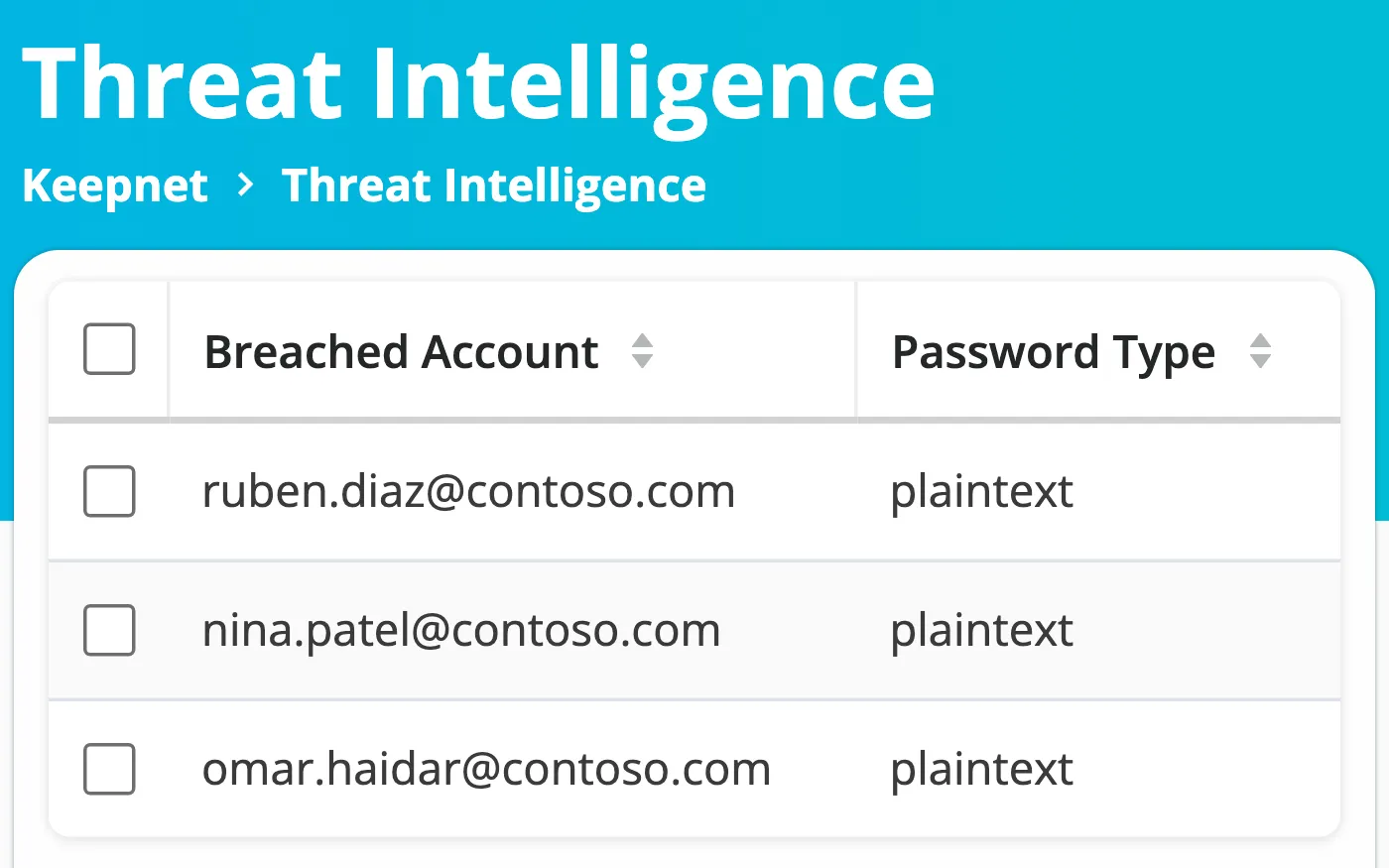
1. Find
Your verified email domains, checked for leaked data on the web.
- Every address on your verified email domains
- Scanned continuously, so new leaks are added
- No employee is contacted
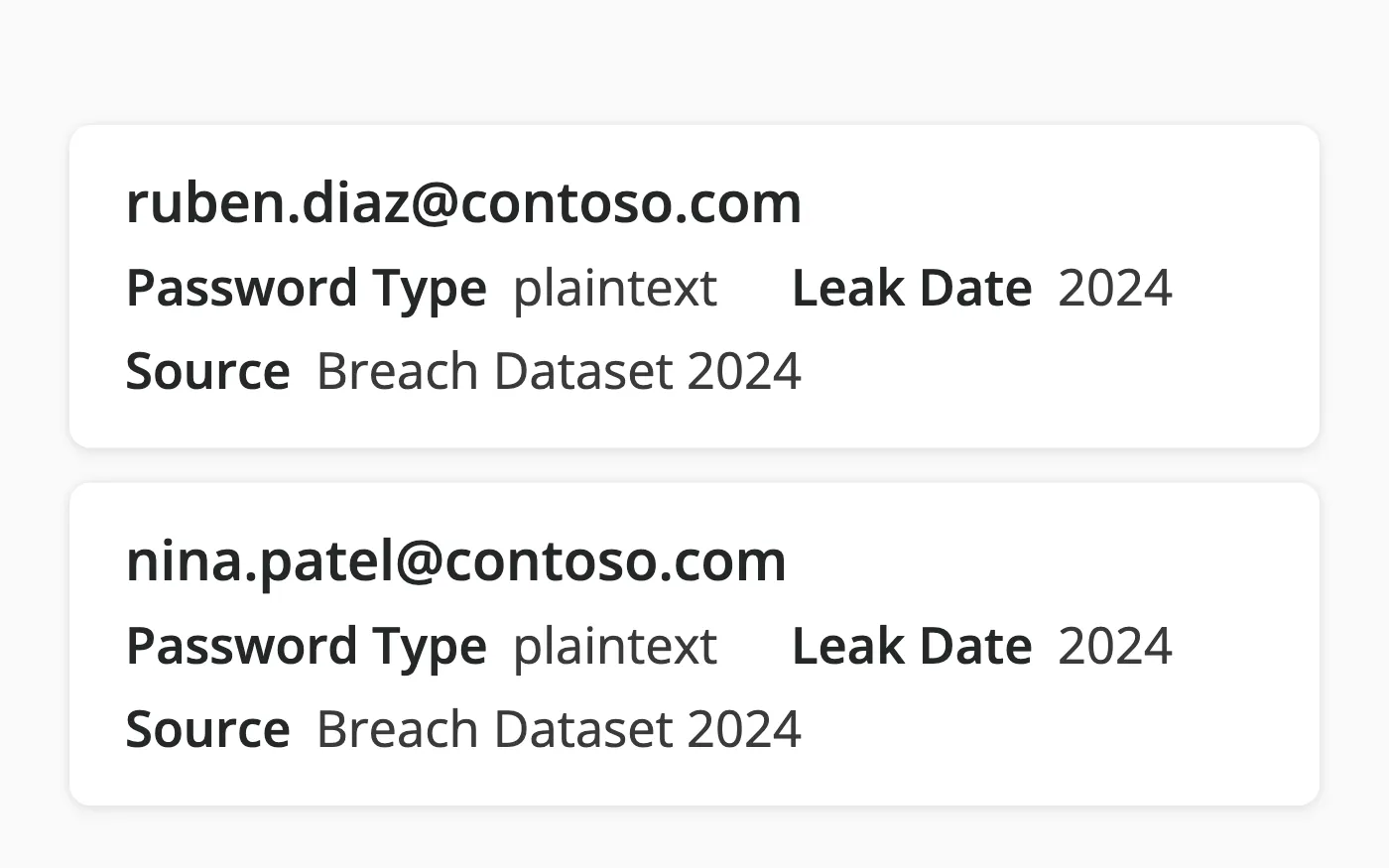
2. Report
How exposed each account is.
- Account and password type
- The source and the leak date
- Export the findings
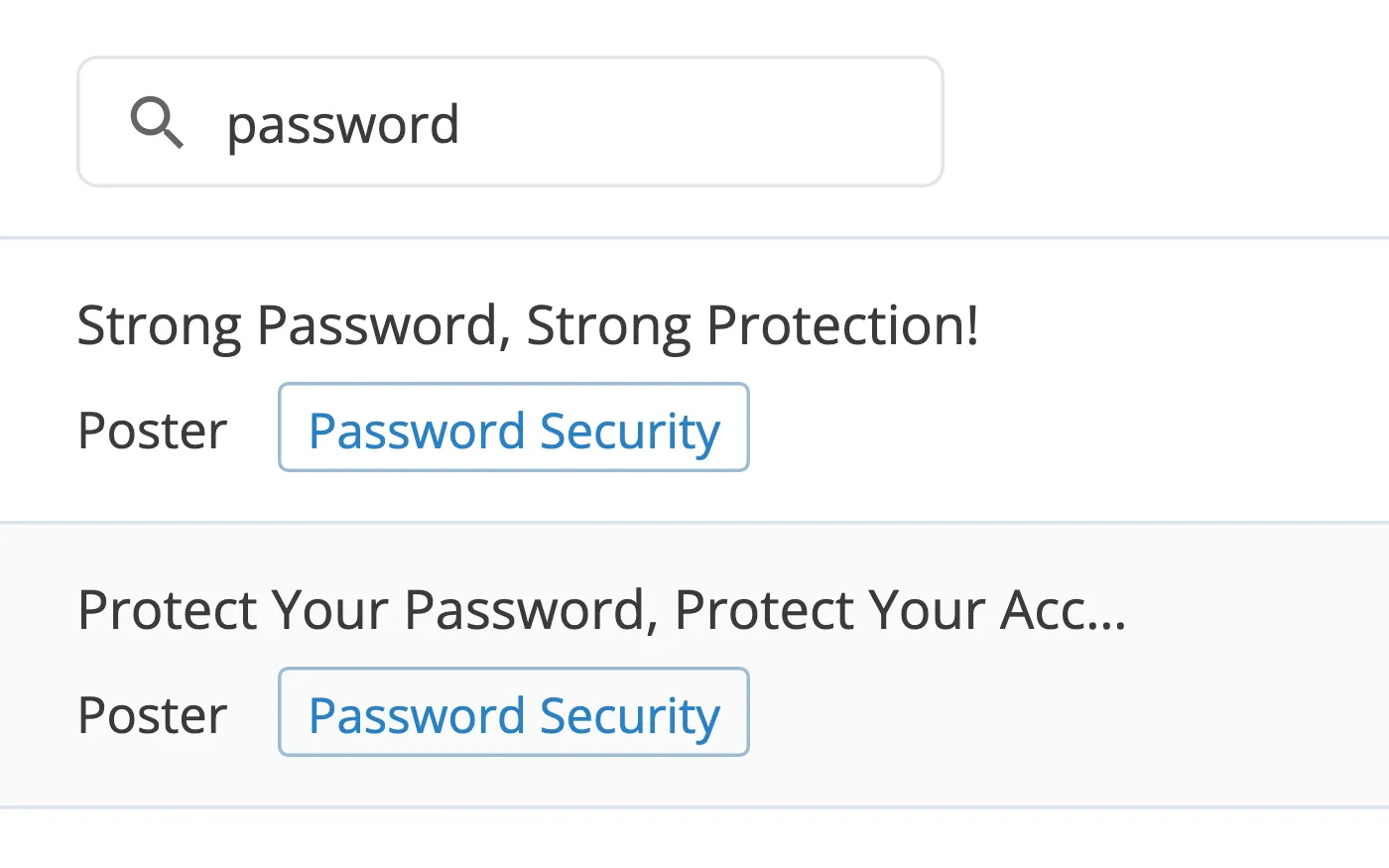
3. Act
You choose the follow-up for each exposed employee.
- Enrol them in a password training
- Include them in a phishing simulation
- Or pull the findings through the REST API
Follow up on each leaked credential
Targeted training
Enrol the exposed employee in the right training.
Targeted simulation
Follow up with a phishing simulation.
Into your SOAR
Pull the findings through the REST API.
The detail you need to judge the risk
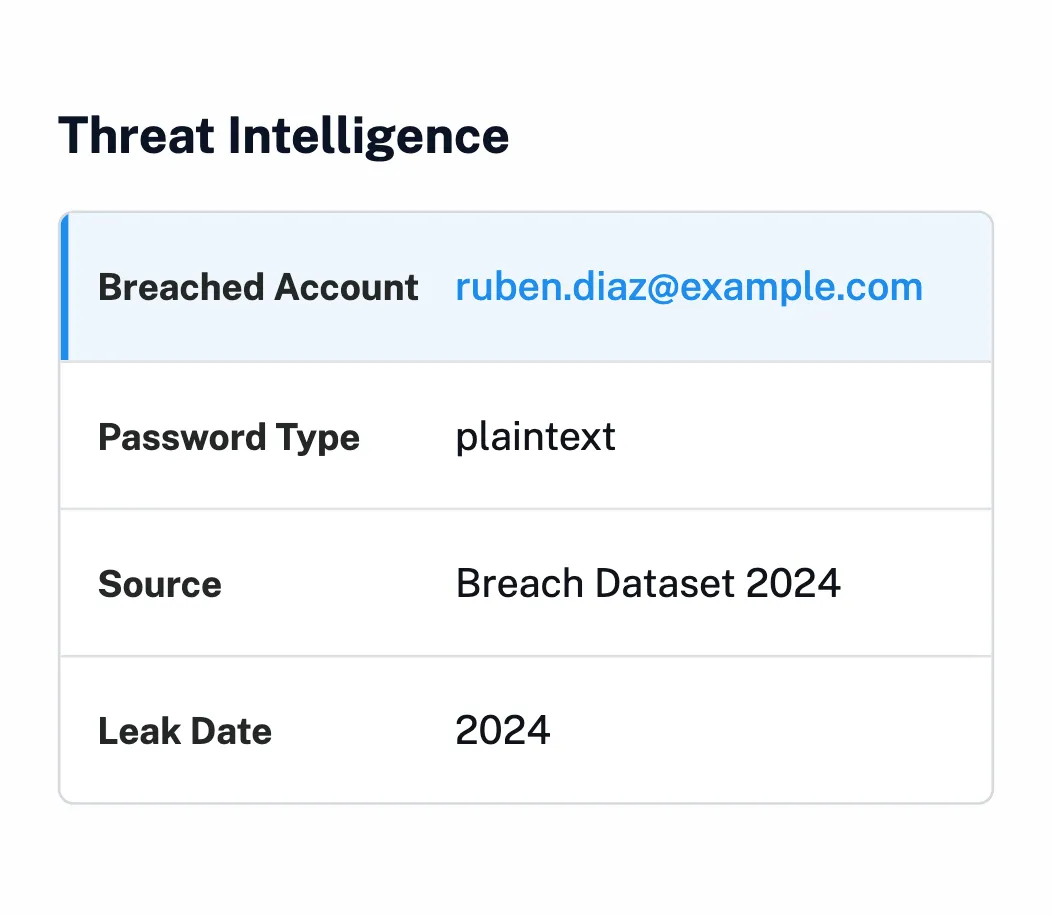
The account
The employee email found in a breach.
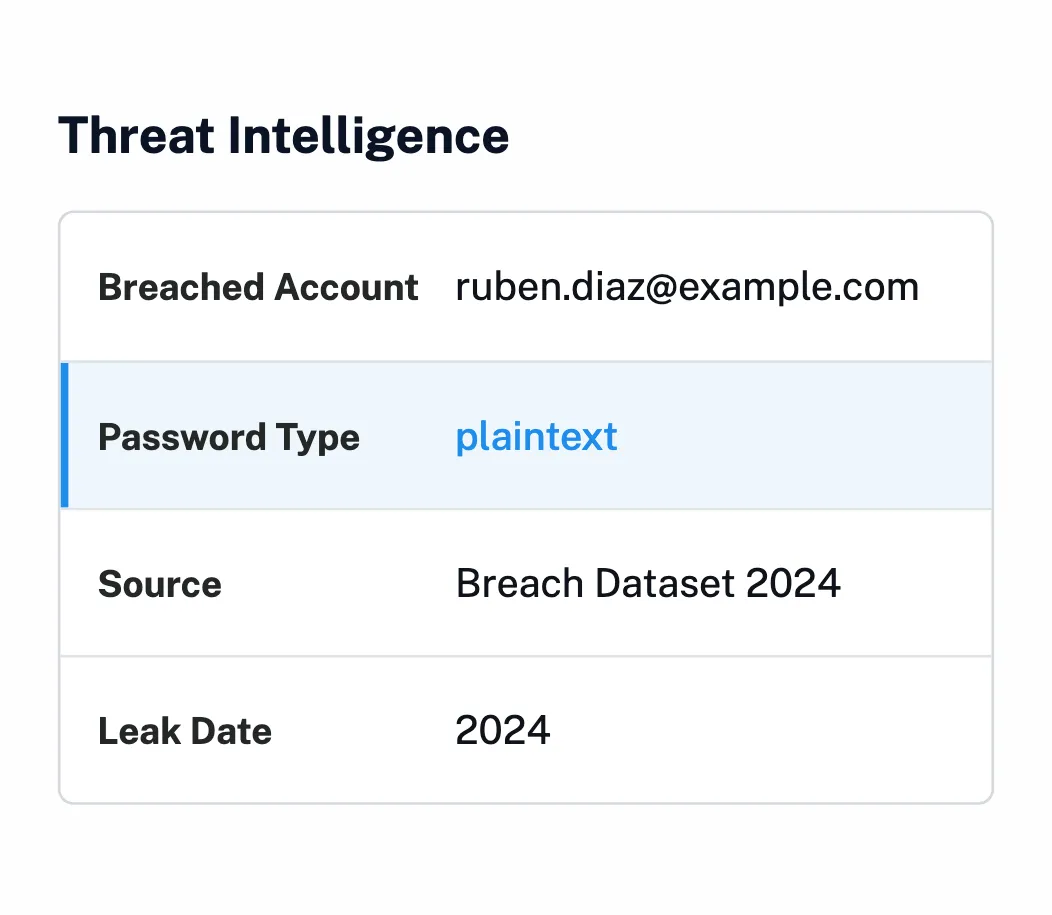
Password type
Cleartext, hash or MD5, so you can judge the risk.
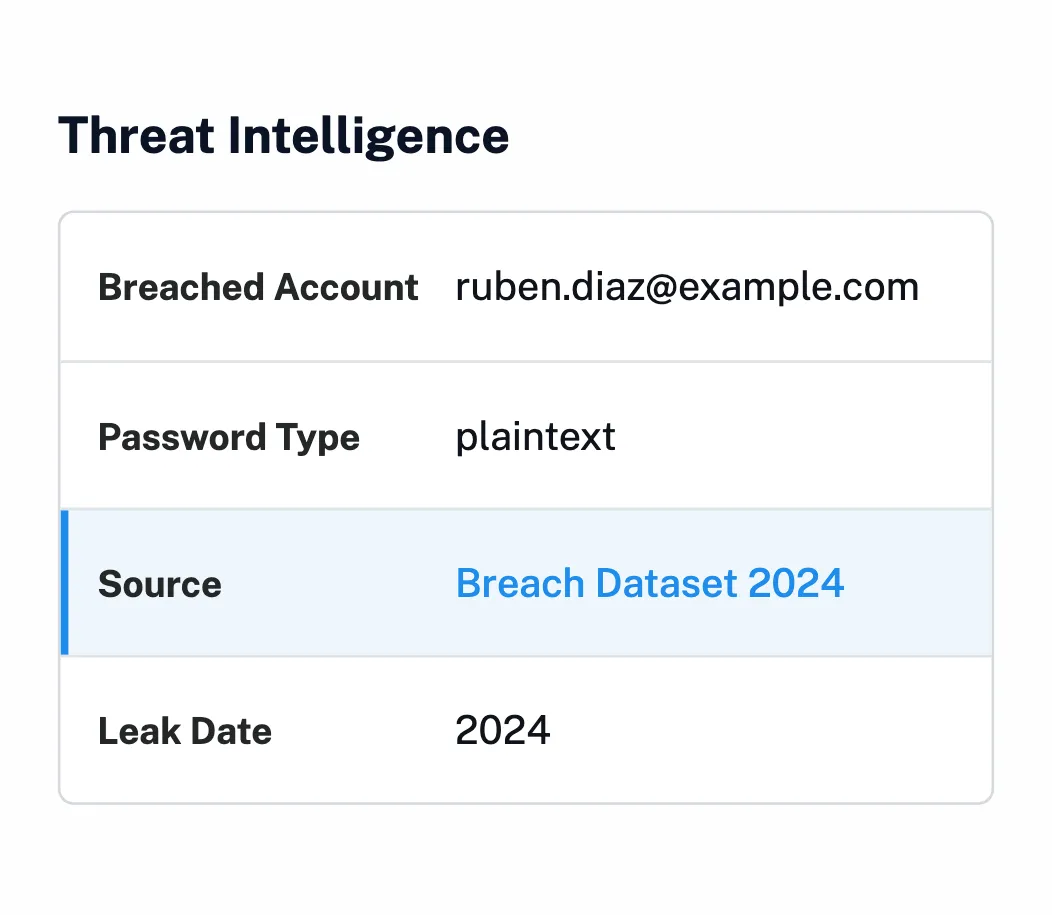
Source
The breach it leaked in, or the name it was leaked under.
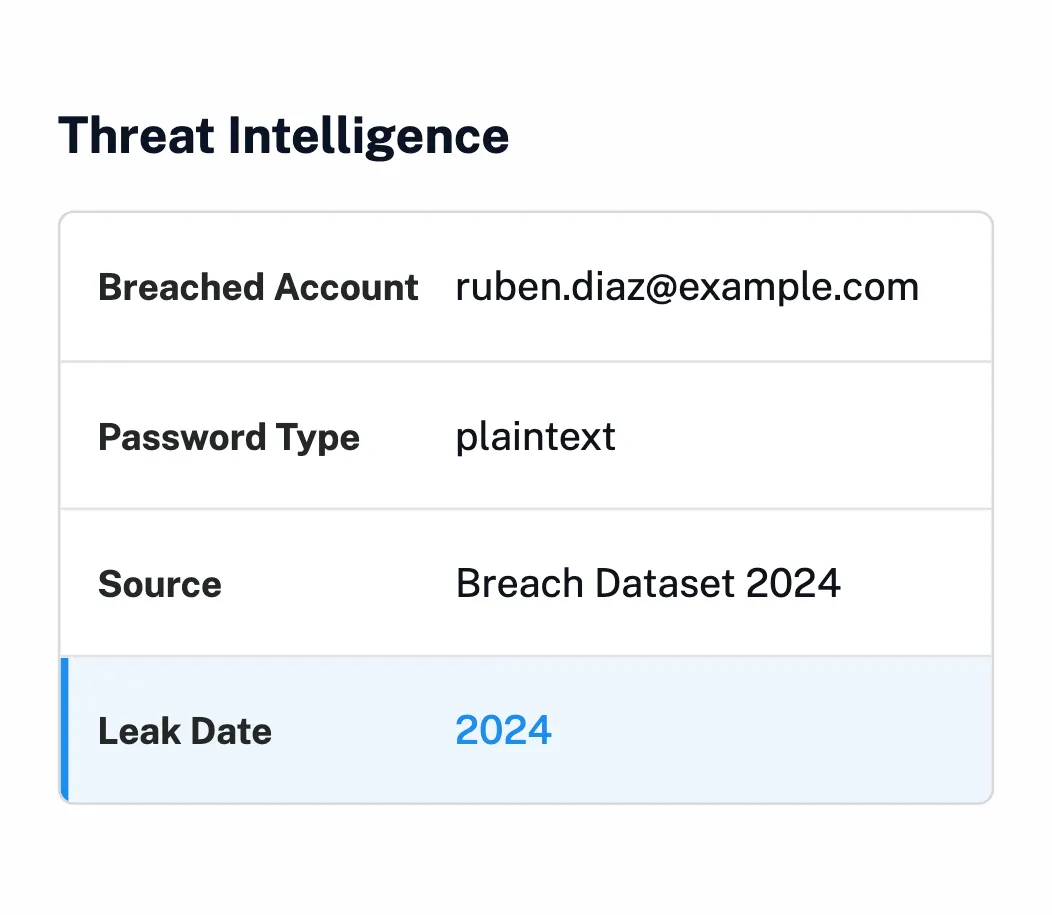
Leak date
When it was exposed.
Questions to ask a compromised credential vendor
| Question | Keepnet |
|---|---|
| Does a finding lead to action? | Yes. Enrol the employee in training or a simulation, or pull the findings into your SOAR. |
| How are leaks matched? | By email address, for every address on your verified email domains. |
| What detail is shown? | Account, password type, source and leak date. |
| Does it show employee passwords? | No. It shows the password type, not the password. |
| Where is the data kept? | In the region you choose. |
| Can we buy it on its own? | Yes. |
The evidence is published, not on request


Four current certifications, independently audited. Certificates and the full control set are published at doc.keepnetlabs.com/resources/compliance.
Pricing
Buy threat intelligence on its own
Priced per employee, as part of the secure behaviour management platform.
See the plan prices- Pay only for what you runStart with one simulator and add the rest later.
- Priced per employeeThe more employees you cover, the less you pay per employee.
- Add to what you runCompromised credential detection alongside your simulations, training and reporting, in one console.
- Try before you commitTry and buy, or a proof of value with your own employees.
"It would be unfair to single out just one feature. The mail scenarios and customisable training modules are particularly excellent."
"It's a really great platform with a lot of flexibility to ensure our requirements are met. Onboarding was friendly, enjoyable, and thorough."
"It's super easy and intuitive to setup campaigns, whilst making it easier for end-users to report phishing emails."
"The product itself works great on day one and delivers immediate value as our team was able to get started with our phishing exercise program immediately."
"It has been consistent, reliable, and implementations over time shows that they really listen customer feedback."
"We've seen a noticeable improvement in how employees react to suspicious emails or phone calls- because they remember the stories."
"Within minutes, we can create realistic, scenario-based templates specific to our organization, reducing setup time while increasing the relevance of training."
"The simulations and campaigns are very customisable and realistic."
"Thanks to Keepnet's Incident Response tool, we reduced the e-mail analysis and response time, which used to take hours, to 2 minutes."
Gartner's notice on these reviews is at the foot of the page.
Keepnet Labs has a rating of 4.9 out of 5 based on 104 ratings in the Security Awareness Computer-Based Training market on Gartner Peer Insights as of October 2026. Gartner and Peer Insights™ are trademarks of Gartner, Inc. and/or its affiliates. All rights reserved. Gartner Peer Insights content consists of the opinions of individual end users based on their own experiences, and should not be construed as statements of fact, nor do they represent the views of Gartner or its affiliates. Gartner does not endorse any vendor, product or service depicted in this content nor makes any warranties, expressed or implied, with respect to this content, about its accuracy or completeness, including any warranties of merchantability or fitness for a particular purpose.
What buyers ask about leaked credentials
Short answers first.
Compromised, or leaked, credentials are an employee's email address and password that have appeared in a data breach or leak. Attackers reuse them to sign in, so an exposure elsewhere becomes your risk.
Keepnet scans the web for leaked data on your verified email domains and lists each exposed account, with the password type, the source and the leak date.
You see it as a list in the console, and can export it.
From data breaches and leaks that Keepnet finds by scanning the web. They are not sourced from inside your own systems.
The report shows the source and the leak date for each account, so you can judge how exposed it is.
Each employee email found in a breach or leak is listed as a breached account, with the password type, where it surfaced and when. No employee is contacted.
Treat it as a signal, not just a record. Have the password changed, then follow up with the employee: in Keepnet you can enrol them in a password training or include them in a phishing simulation. The findings can also be pulled into your SOAR through the REST API.
It serves the same purpose: Keepnet scans the web for your employees’ credentials exposed in breaches and leaks, and lists each one with its source and leak date. You follow up with training or a simulation in the same console.
No. The report shows the password type, such as cleartext, hash or MD5, so you can judge the risk, not the password itself.
A full threat intelligence platform collects feeds for a security operations centre. This is focused on one job that changes employee behaviour: the credentials your employees have exposed, and what to do about each one.
Yes. It can be bought on its own, or inside a plan with Keepnet's simulations and training.
See your own exposure
- Your employees' leaked credentialsEvery address on your verified email domains.
- The detail on each oneAccount, password type, source and leak date.
- From leak to actionTraining, a simulation or your SOAR.
- Your rolloutWho sees it, and what follows.

Book a demo
Thirty minutes, no cost and no obligation.
Thank you, your request is in
A confirmation is on its way to your inbox.
Thirty minutes with the Keepnet team, on Microsoft Teams. Your details are already filled in.
Prefer to pick a time later? The team will follow up within one working day.
Your demo is booked
A calendar invite is on its way to your inbox, with a Microsoft Teams link.
The booking calendar will not open in this page.
Open the calendar in a new tabSources
- Keepnet console, dash.keepnetlabs.com, read 16 and 17 October 2026: Threat Intelligence breached accounts (account, password type, source and leak date) and the training library. Email addresses are fictional.
- Verizon, 2026 Data Breach Investigations Report, p. 16: credential abuse was the initial access vector in 13% of breaches.
- CrowdStrike, 2026 Global Threat Report, p. 9: 82% of detections in 2025 were malware-free, up from 51% in 2020.
- Keepnet documentation, Threat Intelligence.